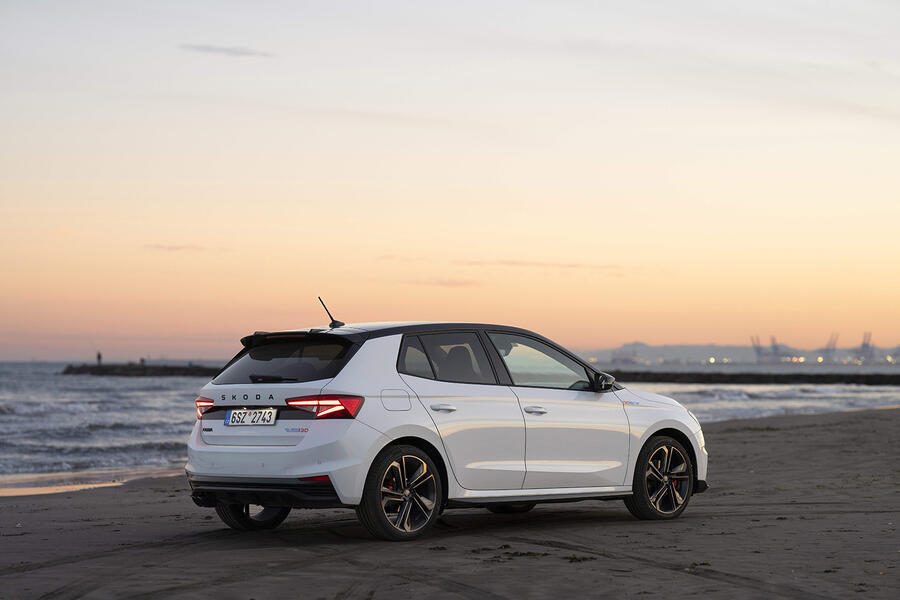
The weight of a new Fabia vRS is potentially resting on this car’s shoulders. Should demand for the Fabia 130 be sufficient, the powers that be in Mladá Boleslav might decide to go whole hog.
Does it do a good enough job to warrant a full-fat version? Yes. Would a future Fabia vRS make it almost irrelevant? Also yes.
This 130 gets its name from two sources: it makes 130kW (174bhp) and Skoda turned 130 earlier this year.
To get to that figure (a 26bhp upgrade), some subtle upgrades have been made to the Volkswagen Group’s ubiquitous four-cylinder 1.5 TSI Evo2 engine.
Its ECU has been modified and bits of the engine have been upgraded to cope with the additional power in a curiously global parts bin special kind of way: larger intake manifolds and charge air pipes from Mexico and thicker cylinder head gaskets from China.
There’s just the one set of 18in wheels to choose from, which the engineers are thrilled about, because it means they can make steering and camber adjustments specifically for this car without worrying about variables in wheel size.
There are a few 130 badges dotted around the outside and beneath the rear window is a solid black stripe (curiously going across, rather than down like a racing stripe) to denote that you’re in a special edition.
It’s available only with a dual-clutch automatic (DSG) gearbox. The 1.5-litre turbo engine can be specced with a manual in a few different Volkswagen Group cars, but not here. Skoda says there won’t be enough demand. But the software of the seven-speed DSG has been upgraded and it now holds on to gears a bit longer to make better use of the additional power.
I wish that it didn’t. The engine sounds very strained in the upper limits of its rev band, especially past 5000rpm. And that’s even with a new exhaust system (which makes this the only Fabia on sale with visible pipes).
The 0-62mph sprint is dealt with in 7.4sec and in-gear acceleration is pretty brisk. The DSG gives off the standard bolt in the back of your seat when changing up in Sport mode to make it really feel like you’re hammering home those shifts. But even with it set to manual mode, it will change up should it feel like you’re stretching the RPM too highly.
There’s a bit of fun to be had with a new ESC Sport mode, which allows for a bit of slip. In something relatively low-powered, it feels great on the road – like something you could actually use and not get into trouble with.
The ride is really good. It’s 15mm lower than a standard Fabia, but there’s not much in it in terms of comfort. Bounce is kept to a minimum, there’s a lot of sophisticated control going on and on the motorway it does a good impression of a Superb, with little pitter-patter coming through the seat or steering wheel.
A bit of heft is added to the feel of the steering in Sport mode, but no matter which mode you’re in there are strong levels of feedback when you want to tip it into a corner. It weights up nicely, slowly and warns you about upcoming understeer. It seems to suggest that you should back off about now rather than deliver through-the-hedge torque steer.
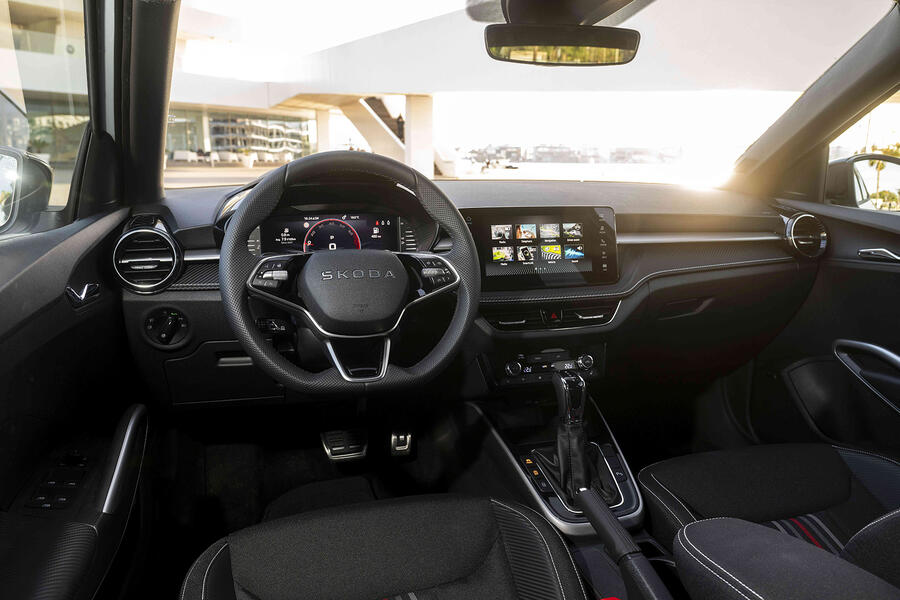
Inside, the 130 is much the same as other Fabia: good quality, a few cheaper bits of plastic if you go searching, plenty of buttons, an intuitive user experience but ultimately feeling its age. The infotainment, in terms of size, fonts and features, is really looking old compared with younger competition.
If it’s a hot hatch you’re after, this is not it. It’s pretty sharp but ultimately not that quick. If this car is framed as a warm hatch, something that’s a bit of fun but whose primary objective is not to have fun, then it’s a much simpler sell, as Skoda’s entry into this market comes at a time when nearly every other manufacturer is leaving it.
This generation of Suzuki Swift doesn’t have a Sport, the Hyundai i20 N finished in 2024, the Vauxhall Corsa hasn’t had a fast version for more than five years and the Ford Fiesta isn’t even a thing any more. So Skoda pretty much has this niche within a niche wrapped up.
The 130 is a bit of a curious contradiction. It’s largely good – keen steering, sensible, well-put together, economical – but it just isn’t hugely entertaining to drive. In other words, it’s crying out for a vRS. Yet if you want one of those, the best thing you can do is buy one of these.