By a wide margin 2023 was the hottest year on record — and
scientists warn that the weather could only get warmer.
Challenges in Reducing the Carbon Footprint of EV
Batteries
Amid escalating global temperatures and extreme weather events,
the automotive industry faces increasing pressure to reduce carbon
footprint. Rising worldwide EV battery demand is expected to
alleviate some climate change effects, but it's little respite.
Inherent risks and automotive challenges across the electric
vehicle's life cycle make realizing their true environmental impact
challenging.
Sustainability in Automotive Industry: EV Battery Focus
Decarbonization in the mobility sector is now a matter of
necessity. As wildfires, heatwaves, water stress, and hurricanes
become more frequent, they cause ecological and social disruptions
and expose companies' assets to physical risk. The transportation
sector accounts for a quarter of global greenhouse gas emissions
and is receiving a solid push from government action and regulatory
frameworks to pivot toward sustainability in the automotive
industry.
Global initiatives such as the Paris Agreement 2015, which aims
to limit global warming to 1.5°C above pre-industrial levels by
2050, have set a clear precedent. Fifteen countries have already
signed net-zero regulations into law, while another 50 countries
have pledged to carbon-neutral targets. The financial sector
displays similar commitments with central banks, ESG automotive
frameworks, and stock exchanges integrating environmental, social,
and governance (ESG) considerations into their reporting and
operating requirements.
Decarbonization Strategies for EV Battery Production
At the heart of the sustainability in automotive industry is the
EV revolution. Once a niche market, EVs are now seen as a critical
component of the decarbonization strategy. However, the transition
to electric vehicle faces environmental concerns and sustainability
challenges, particularly regarding the production and lifecycle of
EV batteries.
Understanding Carbon Footprint of EV Batteries
The carbon footprint of an electric car is not confined to its
tailpipe emissions—non-existent in EVs—but is intricately
linked to its battery.
Efforts to Reduce Carbon Footprint in EV Battery
Production
The EV battery production phase, which involves extracting and
processing minerals like lithium, nickel, and cobalt, is
particularly energy intensive. For example, the cathode and anode
materials alone constitute about 72% of the total emissions from EV
battery production. This aspect is concerning as it represents a
significant portion of the electric vehicle's overall environmental
impact.
To further complicate the matter, there are automotive
challenges in assessing the carbon footprint of EV batteries. The
boundaries of EV carbon footprint — whether cradle-to-gate,
cradle-to-grave, or well-to-wheel — significantly influence the
results and interpretations of these assessments. Different
boundaries in carbon footprint calculations can lead to varying
conclusions about where to make the most impactful emissions
reductions, affecting everything from consumer choices to
regulatory policies.
Environmental Impact of EV Batteries and Mitigation
Efforts
The United Nations, European Union and other major countries are
attempting to establish globally recognized standards and provide
much-needed consistency in carbon footprint calculations. While
this homogenization remains a work in progress, automakers,
regulators, and electric vehicle battery manufacturers must
increase their efforts to mitigate carbon emissions from BEVs
across the value chain.
S&P Global Mobility's High Voltage Battery Forecast projects
a 24% compound annual growth rate (CAGR) for global electric
vehicle demand, from 750 GWh in 2023 to over 3400 GWh by 2030. With
this surge in electric vehicle demand, the automotive industry
faces a dual challenge. Not only does it need to ramp up production
to meet this EV demand, but it must also ensure that this expansion
does not come at an unsustainable environmental cost. Companies
such as Tesla, BYD, and General Motors aggressively pursue carbon
neutrality, focusing on carbon neutral batteries by integrating
advanced technologies and renewable energy sources into their EV
battery production processes to reduce carbon footprint.
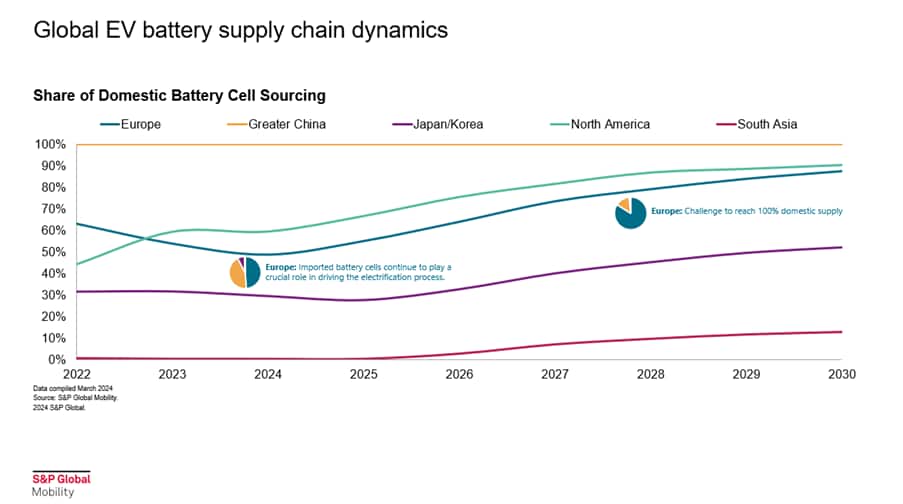
The scale of emissions from batteries for electric vehicles by
2030 is estimated to be equivalent to the carbon footprint of 39
million people globally, reinforcing the need for aggressive
strategies to reduce carbon footprint across the EV battery
production lifecycle. Europe is leading the way with stringent
regulations that push for lower carbon footprints in EV battery
production, which may slow their progress towards becoming fully
self-reliant on domestic supply.
In contrast, China, as a significant battery producer and
exporter, now faces the challenge of reducing its higher carbon
footprint in EV battery production to meet these European
standards. With emissions per kWh of cell manufacturing measured at
about 17 kilograms of CO2 in 2022, China is focusing on reducing
this to sub-10 levels by 2030 through electrification of
gigafactories and investing in provinces with abundant
hydroelectricity. Decarbonizing cathode and anode material
production is also critical, given their significant contribution
to the overall carbon footprint of an electric car. Together, these
changes are setting a precedent that could define the future of
automotive manufacturing worldwide.
Future of EV Battery Production
Moreover, the entire supply chain, from mine to market, is under
scrutiny for its environmental impact, emphasizing sustainability
in the automotive industry. The concept of “scope emissions,” which
categorizes emissions into direct, indirect, and supply chain
categories, is helping companies identify and mitigate their
environmental impacts. Using renewable energy in EV battery
production and adopting carbon-neutral shipping practices, along
with carbon-neutral batteries, are becoming increasingly common.
Such practices are examples of innovations in supply chain
management.
Consumer Impact on Sustainability In the Automotive
Industry
The push for decarbonization is also reshaping consumer
expectations. Today's consumers are more environmentally conscious,
often willing to pay a premium for sustainably produced goods. This
shift is influencing the electric vehicle market and the broader
manufacturing landscape as companies across industries strive to
align themselves with their customers' values.
However, achieving true sustainability in the automotive
industryrequires more than clean manufacturing processes. It
necessitates a holistic approach considering the electric vehicle's
entire lifecycle, from design and production to end-of-life
recycling. The future of mobility, therefore, lies not only in
electrification but in a comprehensive rethinking of how an
electrical vehicle is made and used.
As the industry navigates these complex sustainability
challenges, the role of international cooperation and technological
innovation becomes increasingly apparent. The journey towards
sustainability in the automotive industry is not a solo race but a
collective effort that spans continents and industries. With the
right mix of policy support, corporate governance, and consumer
engagement, the goal of a carbon-neutral mobility sector will be
within reach.
This article is part of a series featuring highlights from
S&P Global Mobility's 2024 Solutions Webinar Series. Objective
Assessment of Battery Cell Contributions to Carbon Footprint
webinar occurred on April 11, 2024.
Register for additional webinar sessions.
Source link
