Reimagined in Aluminum
The Datsun 240Z is undeniably a classic, but like many vehicles from its era, it suffered from several well-known issues – most notably rust. This particular example, however, appears to have addressed that problem almost entirely, with most of the body replaced with aluminum.
Renowned automotive photographer Larry Chen interviewed the car’s owner, Topher Pine, who worked closely with Japanese Z specialist Star Road to bring the ambitious concept to life. Pine explained that the car is constructed using 5000-series aluminum and said that many of the body panels were stamped at the same facility where the “new Lexus LFA” and various Toyota prototypes are currently being produced.
A Lighter Touch
Most production cars are built using a mix of steel, aluminum, and plastics to balance strength, weight, and manufacturing costs. As such, going nearly all-aluminum is an unusual approach. Pine claims the extensive use of aluminum has reduced the car’s weight by roughly 70 kilograms (about 154 pounds), which should improve its power-to-weight ratio. He also noted that magnesium was incorporated into certain components to improve resistance to corrosion, and that the aluminum doors are said to be 1.6 times stronger than the original steel units.
Other vehicles have taken a similar approach using different materials. The Tesla Cybertruck and the DeLorean DMC-12, for example, both use all-stainless-steel construction, which typically offers improved durability at the expense of additional weight. At the other end of the spectrum, ultra-lightweight builds often turn to carbon fiber, despite its high cost, with models like the McLaren Senna relying heavily on the material.
In this case, the aluminum construction of the featured 240Z represents a practical alternative, offering a material that is lighter than steel and significantly less expensive than carbon fiber. However, some steel components remain, including sections of the A-pillars, headlight housings, rocker panels, the rear roll pan, and door reinforcements.
Powering the build is a turbocharged 2.5-liter RB25 inline-six engine, which replaces the original naturally aspirated L24. Pine told Chen that the engine has not yet received extensive modifications, though his target output is between 400 and 450 horsepower.
Larry Chen on YouTube
Still a Work in Progress
Additional upgrades include a Star Road big brake kit and suspension components, along with seats, harnesses, and a steering wheel supplied by Number 7 Racing. Pine also said he is still deciding on a final paint finish, but intends to preserve the distinctive all-aluminum character of the car.
The build was showcased at SEMA 2025, though details on availability were not mentioned in the interview. However, Pine mentioned in a social media post that the all-aluminum 240Z body panels developed with Star Road will be available after the Tokyo Auto Salon, where Toyota’s new flagship sports car, the Toyota GR GT, is expected to make its debut.
Larry Chen on YouTube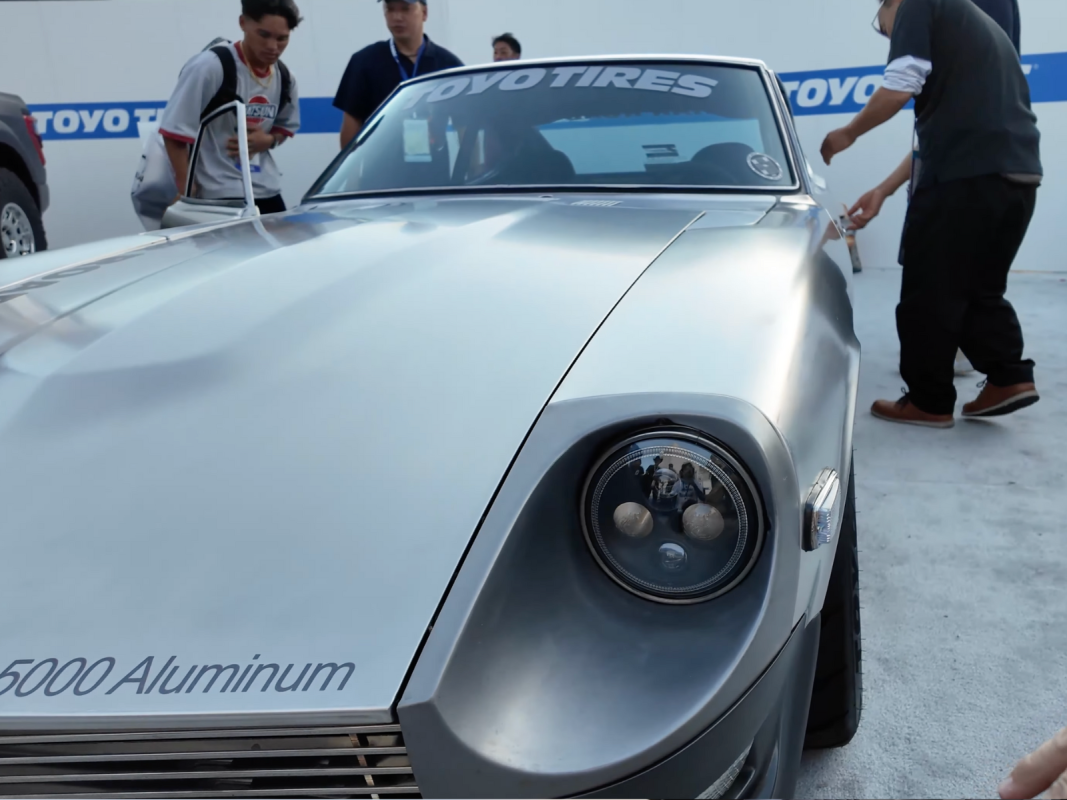
View the 4 images of this gallery on the
original article
