Modern problems require modern solutions
The steering wheel has been the command center of every car for a very long time. For much of the history of cars, it has been the one constant in automotive interior design; the piece of hardware that connects humans to their machine, drivers to the road. Here’s the thing: as self-driving technology evolves, robotaxis and autonomous vehicles become more of a reality, the traditional steering wheel starts to become less of an essential tool and more like an awkward instrument in your way.
Although this technology is becoming increasingly prevalent, we’re not yet living in a fully autonomous world, which has created an interesting problem. Some people still want the option to drive manually, whether for fun, safety, or simply because certain roads and conditions aren’t quite ready for Level 4 automation.
Autoliv
View the 2 images of this gallery on the
original article
Enter the folding wheel
Autoliv and Tensor just answered that dilemma with something straight out of a concept car: the world’s first foldable steering wheel for production autonomous vehicles. This breakthrough technology will debut in the Tensor Robocar, which is expected to begin production in the second half of 2026.
The idea is very simple: it is a steering wheel that retracts when you don’t need it. In typical operation, the Robocar can be driven like a conventional car with traditional controls like your everyday commuter. However, when the Tensor switches to Level 4 mode, the steering wheel retracts to clear the driver’s area, creating a spacious and flexible cabin that can adapt to whatever you need. It “reimagines the cabin as a multifunctional space,” whether you’re working, relaxing, or enjoying the ride.
What makes the system more clever is that the in-car safety systems also adapt, whether it is in traditional, “manual” driving, or in Level 4 autonomous mode. Autoliv, the global leader in automotive safety systems and co-developer of the folding wheel, reimagined how airbags function in a dual-mode vehicle. When the steering wheel is retracted in autonomous mode, a passenger airbag integrated into the instrument panel is enabled.
However, while in “manual” driving mode, the airbag located within the steering wheel is used. Both configurations deliver equally high levels of protection in a crash, ensuring safety isn’t compromised regardless of which mode you’re using.
“Automotive safety can no longer follow a one-size-fits-all philosophy,” Fabien Dumont, Autoliv’s Executive Vice President and Chief Technology Officer, explained. “We asked ourselves how to make safety intelligent and adaptive—creating a system that seamlessly aligns with the driver’s needs.”
In a statement, Jay Xiao, CEO of Tensor, emphasized the practical benefits of this dual-mode approach, specifically that while full self-driving technology can be exciting, some drivers will opt to take the wheel. He adds that his latest invention with Autoliv not only provides adopters the freedom to choose, but pushes the envelope in new vehicle design.
Tensor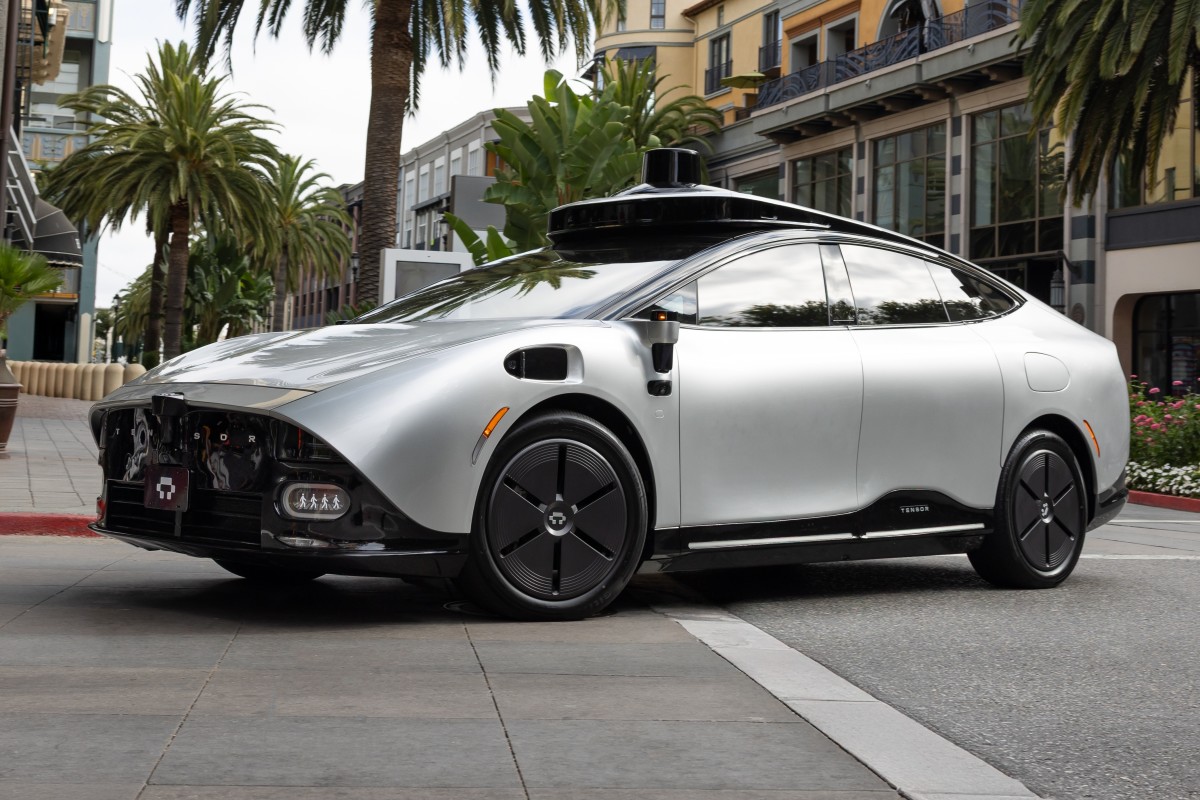
“Fully self-driving technology provides a groundbreaking user experience, but manual driving in certain scenarios is still desired by many people. Our dual-mode approach with a foldable steering wheel combines the best of both worlds and gives customers the freedom to choose,” said Jay Xiao, CEO of Tensor. “Foldable steering wheels previously existed only in concept cars—now we are bringing this innovation to volume-production vehicles for everyday use.”
This new tech will be used in Lyft’s next robotaxis
This new, innovative tech is coming to Tensor’s Robocar; the first personally-owned autonomous vehicle to be “Lyft-ready” from the factory. Not only will regular, everyday people be able to hail rides piloted by driverless vehicles, but the public will also be able to own the very autonomous cars that’ll be doing the driving.
In short, by owning a Tensor Robocar, you would not only be able to use it to shuttle you, your family, and your friends around on day-to-day activities, but you’ll be able to put it to work as a hailable Lyft vehicle and earn money for you during extended periods of time when you’re not in it. In a statement at the time, Jeremy Bird, Executive Vice President of Driver Experience at Lyft, noted that this would overcome the human element needed to earn on its platform.
“Lyft has created opportunities for millions of people to earn on the platform, but right now, one of the last barriers to rideshare is time — you have to physically be in your vehicle to give rides and earn,” Bird said. “What’s exciting about Tensor is they’re advancing the opportunity that Lyft already creates, removing that final obstacle while reinforcing our vision of a hybrid transportation future.”
Final thoughts
In a statement from both Autoliv and Tensor, their partnership represents more than just clever engineering, as it is “a broader vision where leadership in automotive safety extends beyond crash performance to encompass intelligent, user-centric design.” All in all, these companies are setting a new standard for how in-car safety systems can adapt and enhance the overall driving experience (or passenger experience).
The Tensor Robocar is set to launch later this year in the U.S., European, and Middle Eastern markets, marking a significant milestone in how we think about car interiors as a whole. This is some futuristic concept from The Jetsons; a future of cars where in-car technology doesn’t just drive for us, but can physically transform and adapt around us.
